How to Start Teaching Music Online: Guitar, Piano and Singing from Home
Published on August 14, 2026 · Clases Personalizadas Editorial
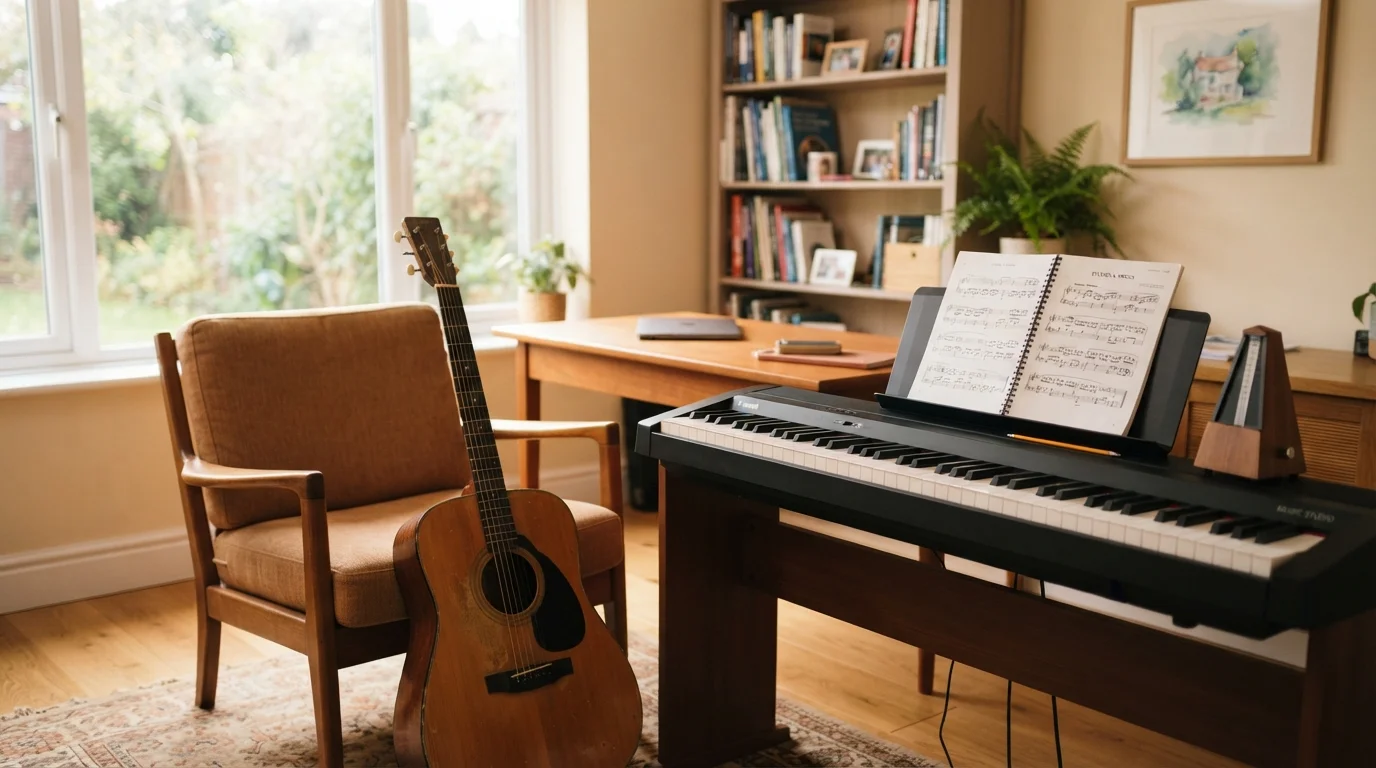
Teaching music online has steady demand: adults pay for a hobby they care about, and parents want their kids' first music lessons. If you already play an instrument, you are one decent microphone, a well-aimed camera and a clear method away from your first class.
Why Online Music Lessons Work (and Who Pays for Them)
The instrument and the teacher's hands show clearly on camera. Unlike other subjects, online music keeps what matters from an in-person lesson: students see how you place your fingers, how you breathe before singing or how you attack a key, and they can imitate you on the spot. You can also record the session and send it afterwards, an extra value a face-to-face class cannot offer.
Who pays for these lessons? First, adults with a lifelong hobby on hold: people who put a guitar in the closet ten years ago and now want to play one specific song, or who always wanted to sing better and never dared to try. They are steady students who pay regularly and rarely haggle when they see progress. Second, parents looking for their kids' first music lessons without the commitment of driving to a music school.
The online format also fits the schedule of the person paying: evening slots and zero commuting. For an adult student, removing the trip to the academy is what turns a good intention into a weekly routine.
Minimum Setup for Your First Lesson
You do not need a recording studio. The priority order is simple: audio first, video second. A decent microphone, which does not have to be a professional condenser, makes more difference than any other purchase, because in music the sound is the content.
Your camera should point at your hands or the keyboard, not at your face against the light. Test the framing before the lesson: the student needs to see finger placement, not your bookshelf. A stable connection and good light complete the basic setup; in music, clean sound beats a feature-packed whiteboard.
As tools, three simple apps are enough: a tuner, a metronome and a sheet music or tab app to share on screen. That covers most guitar, piano and singing lessons.
How to Structure an Online Music Lesson (Basic Template)
The structure that works best is the one used by teachers with the most students: a concrete goal, guided practice and clear homework.
Start with a concrete musical goal, such as a song, a new chord or the intro of a solo, and draw the technique and theory from it. Do not teach abstract theory; teach it when the song asks for it. Then alternate three moments: you demonstrate, the student practises with you and, finally, they play alone while you correct from your side.
Close every lesson with something recorded or written down to practise until next time. The student needs to know exactly what to do when alone: a thirty-second video of you playing the tricky passage is worth more than two pages of instructions.
How Much to Charge for Music Lessons (Honest Ranges)
There is no single price: rates depend on the instrument, your experience and your city. That said, an hour of music sits in a reasonable middle range, similar to languages and slightly below exam subjects.
Within music, the differences are clear: piano and singing usually command more than beginner guitar, and advanced levels justify higher rates because they demand more preparation. If you teach a specialised style, such as jazz, classical voice or production, you can position yourself above the average.
The exercise that works is comparing with local academies in your city and positioning your hour as more flexible and personalised, not as the cheapest. Music students are not looking for the lowest price; they are looking for someone who helps them improve.
Where to Find Music Students
Your ad is your first lesson: it must say what you teach, to whom and how. Post with your instrument, level and style, and let specialisation do the filtering for you.
An ad that works
"Online guitar lessons: classical and pop for beginner adults. Initial and intermediate level, 45-minute sessions, evening slots. Learn to play your favourite songs from home." With instrument, style, audience and format, the right student recognises themselves and the wrong fit does not write to you.
In music, a demo is worth more than any credential: a short video of you playing attracts more than a flawless CV. Record it on your phone, upload it to your profile and let the music do the introduction. Word of mouth among adults and parents works just like in any other subject: a well-delivered first lesson recommends itself.
The Real Challenges (and How to Solve Them)
Online music has three concrete challenges, and all three have solutions. The first is teaching technique remotely: correcting wrist position or breath support requires visibility. Use specific camera angles for each correction and always say what to look at: "turn your wrist" only works if the wrist is visible.
The second is the month-two dropout, typical of adult students once the novelty fades. The answer is planning motivating repertoire and short-term goals: one song every four weeks keeps interest alive better than an endless method book.
The third is technical: video calls compress audio, and singing shows it the most. For serious singing students, ask for a basic microphone from day one; for everyone else, adjust the call's volume and equaliser and that is enough.
Conclusion
Online music has steady students, flexible hours and a low entry barrier if you already play an instrument. Start with minimal equipment, a clear lesson structure and an ad that shows your style, and let the first students do the rest.
Post your free ad on clasespersonalizadas.com and let the music students in your country find you.