How to Take Notes in Class: The Cornell Method and Techniques That Work
Published on August 27, 2026 · Clases Personalizadas Editorial
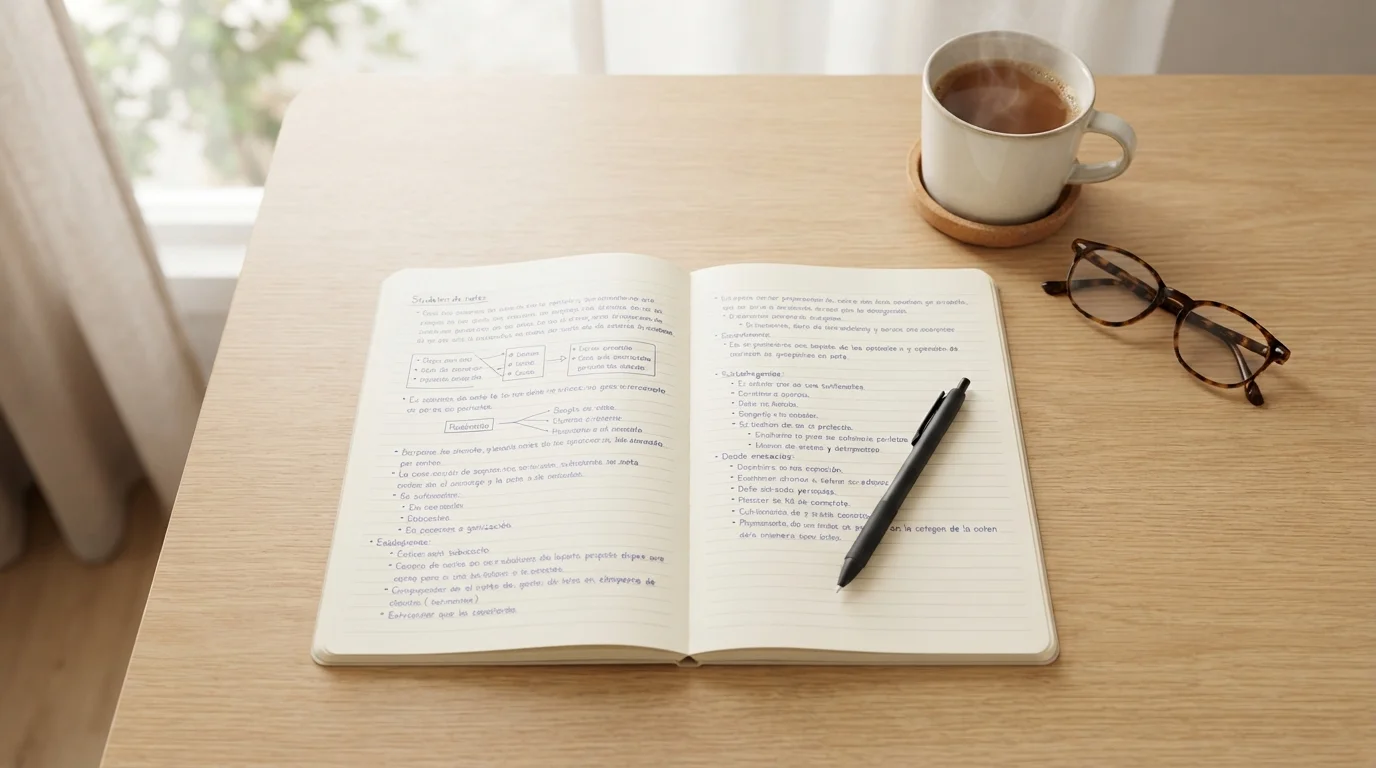
Your notes are useless if you never open them again. If you take notes in class by copying everything the teacher says, you end up with a full notebook and zero learning. The Cornell method fixes that with one page divided into four zones and a review routine that takes minutes.
Why your current notes don't work
Copying what the teacher says is transcribing, not understanding. When class ends you have a complete notebook, but you remember almost nothing because your attention went to how fast your hand could move, not to the content.
The real problem isn't note-taking: it's that your notes have no structure to review. Everything runs together, with no hierarchy, no questions and no separation between what matters and what doesn't. Opening that page a week later feels like reading a brand new text.
The golden rule is simple: notes are taken to study later, not to fill pages. If that notebook never becomes review material, most of your class time is wasted.
What the Cornell method is (and why it's been around for decades)
Walter Pauk created the Cornell method at Cornell University in the 1940s. It divides the page into four zones: the title at the top, a note column on the right that takes up two thirds of the page, a cue column on the left and a final summary at the bottom.
The trick is the cue column. The questions you write there turn review into self-testing: cover the notes, read the question and answer it from memory. That effort of recalling is what psychologists call active recall, and it beats passive rereading by a wide margin.
It works for lectures, for readings and for online classes too. Whether you use paper or a stylus tablet doesn't matter: the structure is what counts.
A Cornell page, in practice
Imagine a history class on the French Revolution. You write the title at the top. In the note column you jot down dates, key figures and causes, in your own words and abbreviations. When class ends, you write cue questions such as: "What economic causes explain the Revolution?", "What role did the bourgeoisie play?" and "What changed after 1789?". At the bottom you close with a two or three sentence summary. When you study, cover the note column and answer those three questions out loud.
How to apply the Cornell method step by step
During class: use only the big column
Use the right column for ideas, data and your own abbreviations. Don't try to transcribe full sentences or copy the slides: when you listen, process and summarize, retention goes up on its own.
Right after class: questions and summary (10-15 minutes)
This is the step almost nobody does, and the one that pays off the most. When class ends, write two to four questions per topic in the left column and a two or three sentence summary at the bottom of the page. Ten minutes that turn your notes into exam material.
Before the exam: active review
Cover the big column with a sheet of paper or your hand and answer the questions out loud. Whatever you miss is exactly what you need to review. Repeat the process in several short sessions instead of one marathon the night before.
Other note-taking techniques and when to use them
Cornell isn't the only option. The best note-takers combine techniques depending on the subject and the type of class.
Outline notes
Organize information in a hierarchy of headings and bullet points. It's ideal for subjects with a clear structure, like history or law, where every topic hangs from another.
Mind maps
They connect concepts visually around a central idea. They work well for subjects where ideas relate to each other, like biology or literature, and for brainstorming before you start writing.
Boxing and charting
They group information into boxes or tables. They're useful for comparing dates, authors or formulas, and for quick review before an exam: the comparison is right there in front of you.
Handwritten or digital: what the science says
A classic study by Mueller and Oppenheimer (2014, Psychological Science) found that handwriting beats typing for retention. The reason: your hand is slower, so it forces you to summarize and process, while the keyboard invites word-for-word transcription.
The takeaway isn't that the device is bad: it's the process. If you take notes digitally, write in your own words, avoid literal transcription and use tables or structured notes instead of walls of text.
In practice, paper wins for diagrams and visual subjects (math, chemistry, technical drawing), and digital wins for searching, organizing and sharing. Many students combine both: handwritten notes in class and a tidy digital summary later.
Reviewing is where you win the exam
Perfect notes that are never reviewed are worth zero. Schedule ten or fifteen minutes of review on the same day of the class: that spaced repetition is what locks content into long-term memory.
Turn your Cornell questions into a quick self-test and make flashcards only for what you miss. You don't need to review everything: you need to attack exactly what you don't retain.
Before you look at your notebook, try to reconstruct the topic from memory. The effort of recalling is what leaves a mark, not passively reading the summary.
Conclusion
Learning how to take notes in class doesn't require magic apps or extra hours: it requires structure and active review. The Cornell method gives you the structure on one page and the review in ten minutes a day.
If a subject keeps resisting even when your notes are good, a private tutor can help you get unstuck with strategies tailored to you. Explore the tutor ads on clasespersonalizadas.com and find someone who can teach you how to study better.